Customers & their kit
Maintenance Plans
Plans and agreements are two different things
A plan is the thing you sell: a name, a price, a billing interval, how often a visit happens, and what the visit covers. It lives in your catalogue and you can edit it whenever you like.
An agreement is one customer on that plan. When they sign up, the terms are copied onto the agreement rather than pointed at the plan. That is deliberate: raising your price next spring should apply to new customers, not silently re-bill four hundred existing ones on the next sweep.
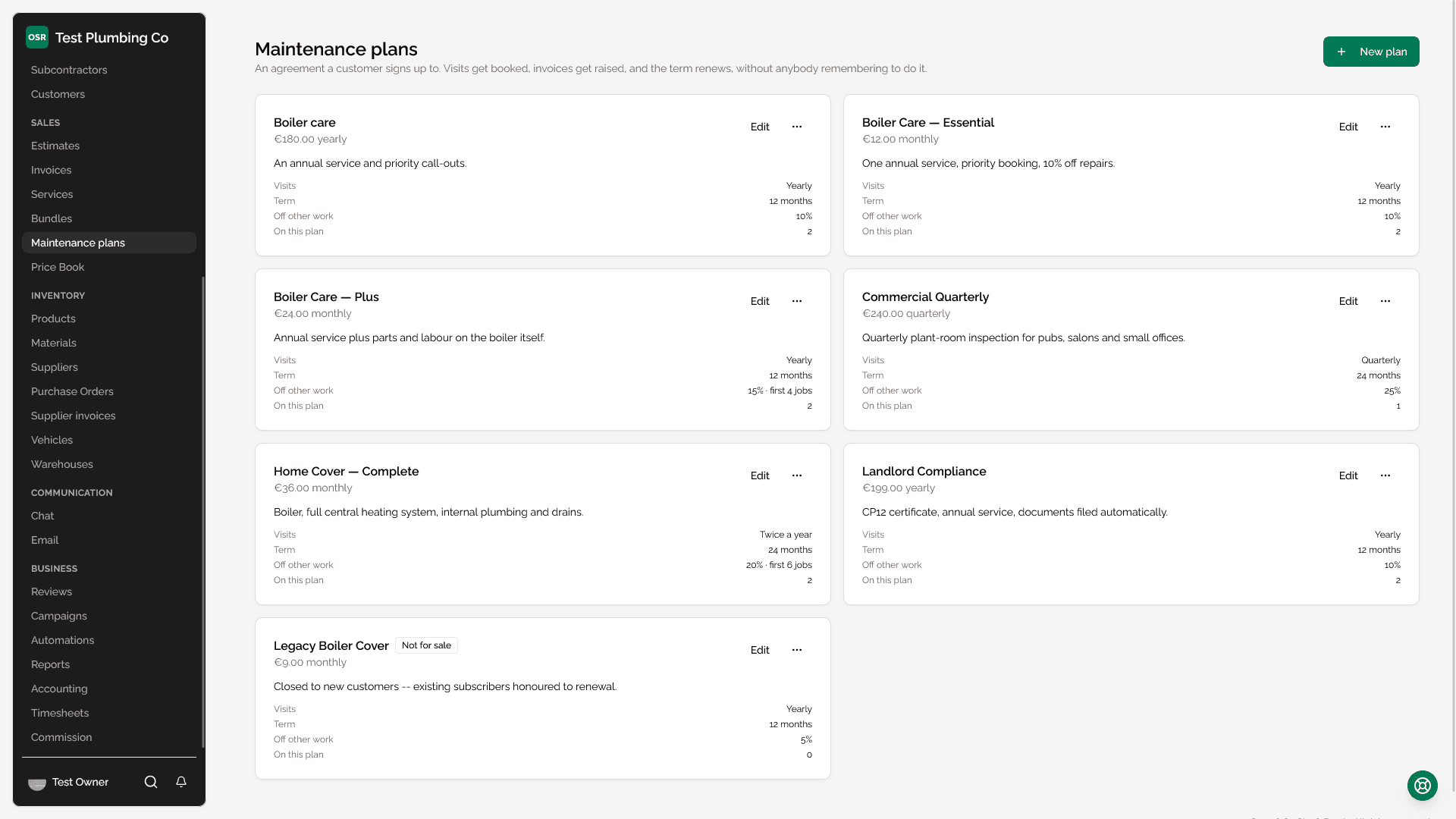
What a plan holds
| Field | What it does |
|---|---|
| Price | What the customer pays each billing period. |
| Billing interval | Monthly, quarterly or yearly. Drives when invoices are raised. |
| Visit every N months | Held as an interval, not as visits-per-year: the sweep schedules from the last visit, and 'three per year' does not say when. |
| Visit summary | What a visit covers, in the customer's words. Becomes the booked job's description. |
| Term | How long the commitment runs before it renews or lapses, in months. |
What happens on its own
A sweep runs regularly and looks for agreements with something due. Each thing it does is claimed before it acts, so a retry, an overlapping run or a clock change cannot book two visits for one date or raise the same quarter's invoice twice.
| When | What happens |
|---|---|
| A visit falls due | A job is created against the agreement's property, described from the visit summary, and the next visit date moves forward. |
| A billing date falls due | An invoice is raised for the agreed price. |
| The term nears its end | A renewal notice goes out. |
| The term ends | It renews for another term if auto-renew is on, and lapses if it is not. |
Worth knowing
Selling one with a job
A bundle can include a maintenance plan at a discount, which is how you sell “new boiler, half-price cover”. The plan is not priced into the bundle: the customer is told what the cover costs before they sign, and approving the estimate puts them on it, billing on its own schedule from that day.
Enrolment happens once per estimate, however many times the customer opens the acceptance page. See Services, Bundles & Price Book for building the bundle itself.
Worth knowing
Cancelling and lapsing
An agreement is active, cancelled or lapsed. Cancelled is a decision somebody made, with a reason recorded; lapsed is a term that ran out with auto-renew off. Neither is deleted, because last year's visits and invoices still have to make sense.
What this does not do